
Introducing EUDR Country Risk Assessments
Palmoil.io’s EUDR Country Risk Assessments combine credible public data with proprietary palm oil deforestation analytics, grievance tracking, and mill-level intelligence to help companies identify, document, and mitigate sourcing risks.

Palm product executives preparing for EUDR due diligence need fast, actionable insight into the environmental, legal, and social risks associated with their sourcing countries. Many may be tempted to reach for a chatbot or AI search tool. But large language models are only as good as the data available to them.
That is a problem for EUDR compliance. Much of the relevant risk information is fragmented, unstructured, outdated, difficult to verify, or not fully public. AI-only reports may be useful for a first scan, but they are not reliable enough to support procurement decisions, supplier risk classification, or defensible due diligence documentation.
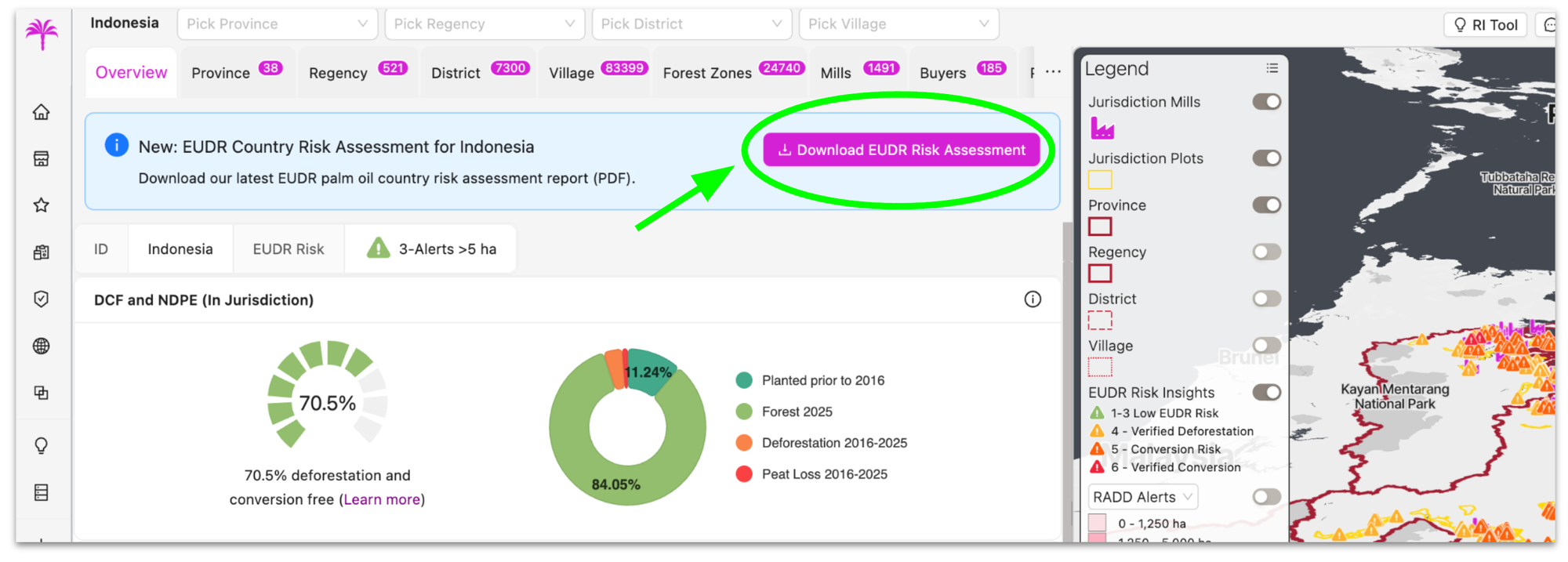
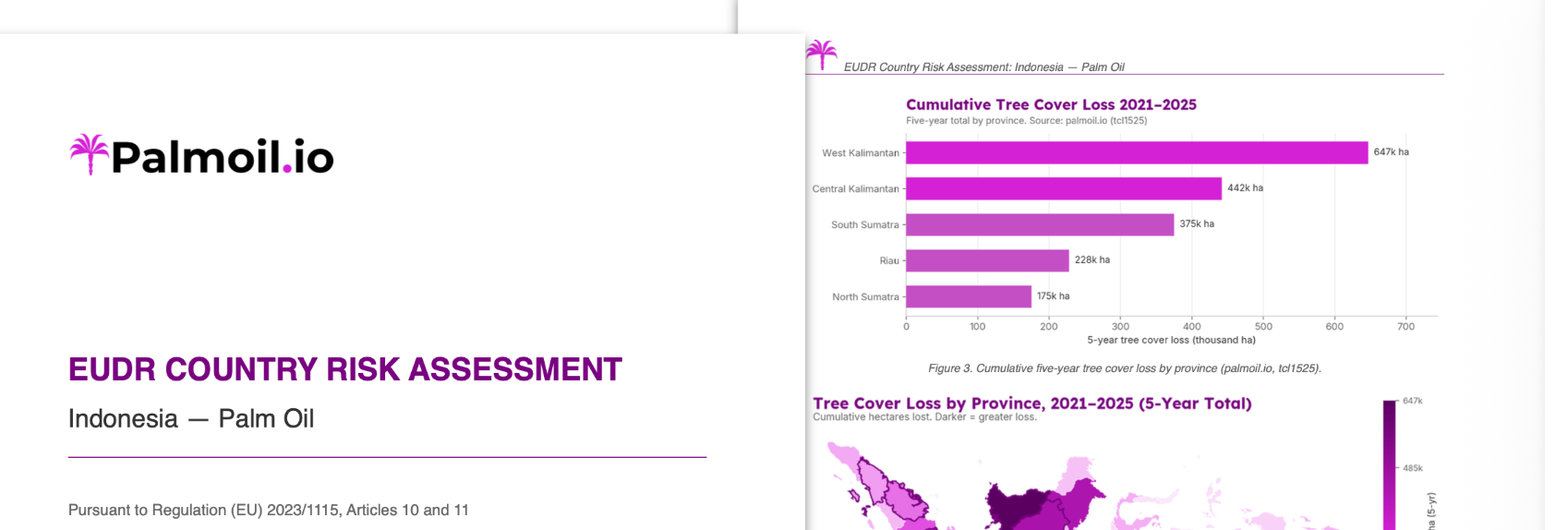
This is why we are launching EUDR Country Risk Assessments for major palm-producing countries. The reports combine reputable public data with Palmoil.io’s proprietary palm oil risk intelligence. This includes deforestation analytics, mill and concession monitoring, grievance data, and analyst-reviewed deforestation reports. The result is a practical, evidence-based assessment designed for EUDR compliance teams, procurement teams, traders, manufacturers, and financial institutions exposed to palm oil supply chains.
Why do I need a Country Risk Assessment?
Under the EUDR, operators sourcing from standard-risk and high-risk countries must conduct a risk assessment before placing relevant products on the EU market or exporting them. That assessment must consider a broad set of country and supply chain risk factors, including deforestation trends, forest prevalence, governance and corruption risks, land rights issues, indigenous peoples’ rights, labor and human rights concerns, substantiated concerns, certification coverage, traceability, and the risk of mixing compliant and non-compliant material.
This is not a one-off exercise. Operators must then show they are mitigating these risks. Country risk needs to be reviewed and updated regularly so that due diligence remains current, evidence-based, and defensible. New deforestation alerts, regulatory changes, enforcement failures, emerging grievances, certification gaps, or changes in sourcing patterns can materially affect risk conclusions. Companies need to actively monitor these risks (using a system like Palmoil.io) and engage with their suppliers to prevent shipment delays and to document a mitigation system is in place.
In practical terms, a Country Risk Assessment helps operators answer a basic but critical question: can we demonstrate that the risk of non-compliance is no or only negligible?
For palm oil, that question is rarely simple. Supply chains often involve smallholders, dealers, collection points, mills, refineries, traders, and manufacturers. Certification coverage is uneven. Supplier lists change. Grievances may be linked to specific mills, concessions, or corporate groups. Post-2020 deforestation risk may vary sharply between regions inside the same country.
A strong country assessment helps teams prioritize due diligence, identify where mitigation is required, and document the reasoning behind sourcing decisions.
What is in a Country Risk Assessment?
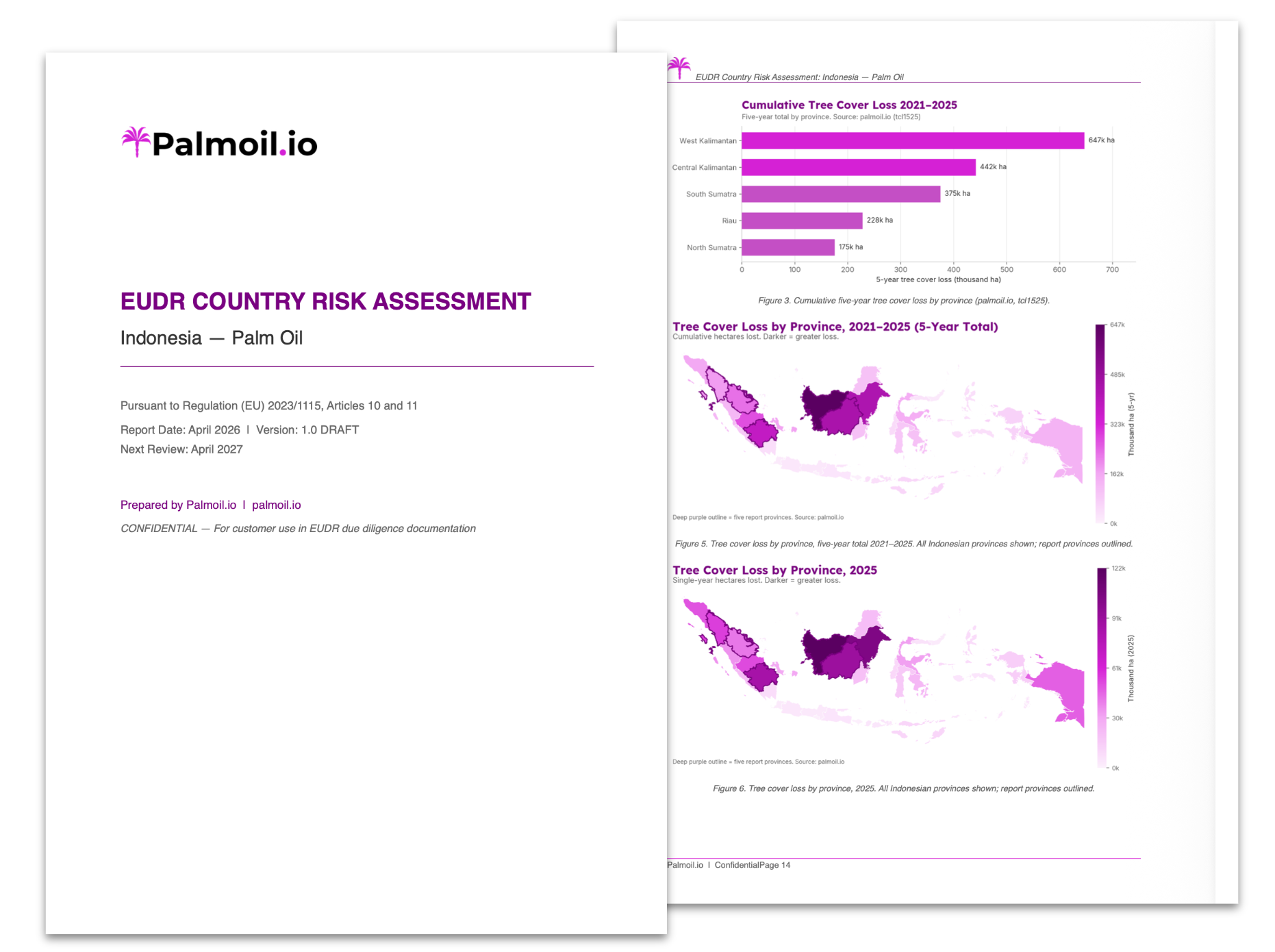
Each Palmoil.io Country Risk Assessment is structured around the EUDR’s risk criteria and tailored to palm oil supply chains.
Country overview
The reports begin with a country overview, including EUDR risk classification, production context, forest presence, remaining forest exposure, and recent deforestation trends. They also assess governance risks such as corruption, weak enforcement, illegal plantation development, licensing problems, and gaps between written law and real-world implementation.
Social risks
The social risk sections cover indigenous peoples, customary land rights, agrarian conflict, labor concerns, human rights issues, and substantiated complaints. These topics matter because EUDR compliance is not limited to deforestation. Operators must also consider whether production complies with the relevant laws of the country of origin, including laws on land use rights, environmental protection, labor rights, human rights, tax, trade, customs, and anti-corruption.
Supply chain and mixing
The reports also examine supply chain complexity and mixing risk. For palm oil, this is essential. Fresh fruit bunches from multiple farms can be aggregated before reaching a mill. Mills may source from company estates, plasma smallholders, independent smallholders, and third-party suppliers. Refineries may then source from dozens or hundreds of mills. This structure creates real challenges for traceability and for separating compliant from non-compliant material.
Certification
Certification is also reviewed, including schemes such as RSPO, ISPO, MSPO, or other country-relevant systems. The reports explain where certification can support due diligence and where it is not sufficient on its own. EUDR compliance requires geolocation, legality checks, deforestation-free verification against the 31 December 2020 cutoff date, and risk assessment. Certification can help, but it does not replace those obligations.
Regional risk distinctions
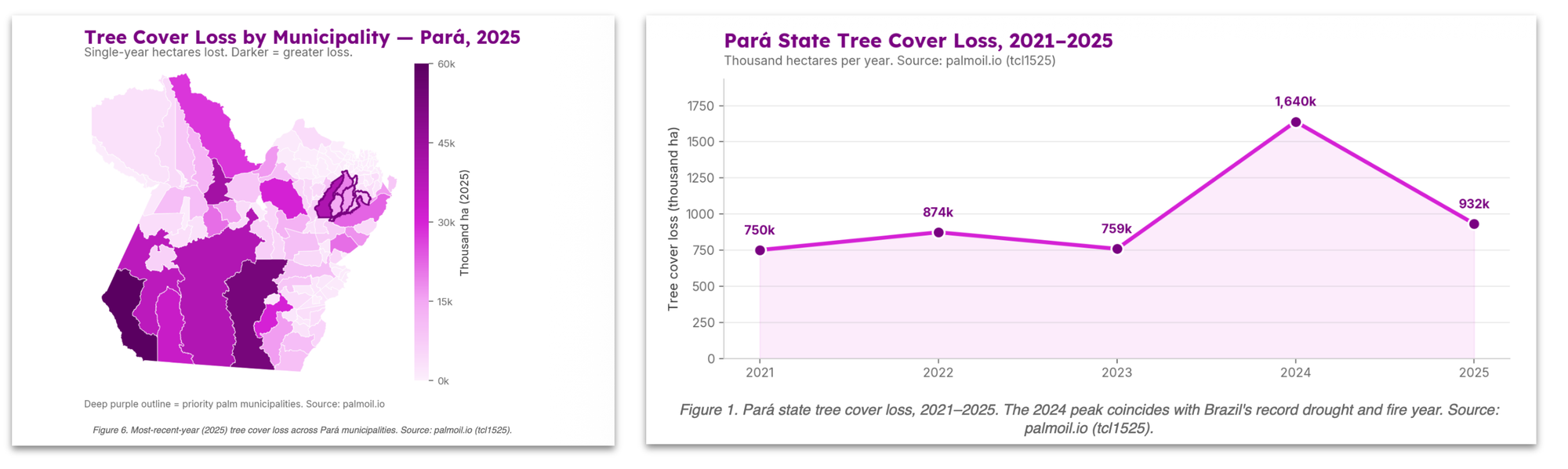
Country-level averages can hide the real risk picture. That is why Palmoil.io’s assessments include regional and subnational analysis.
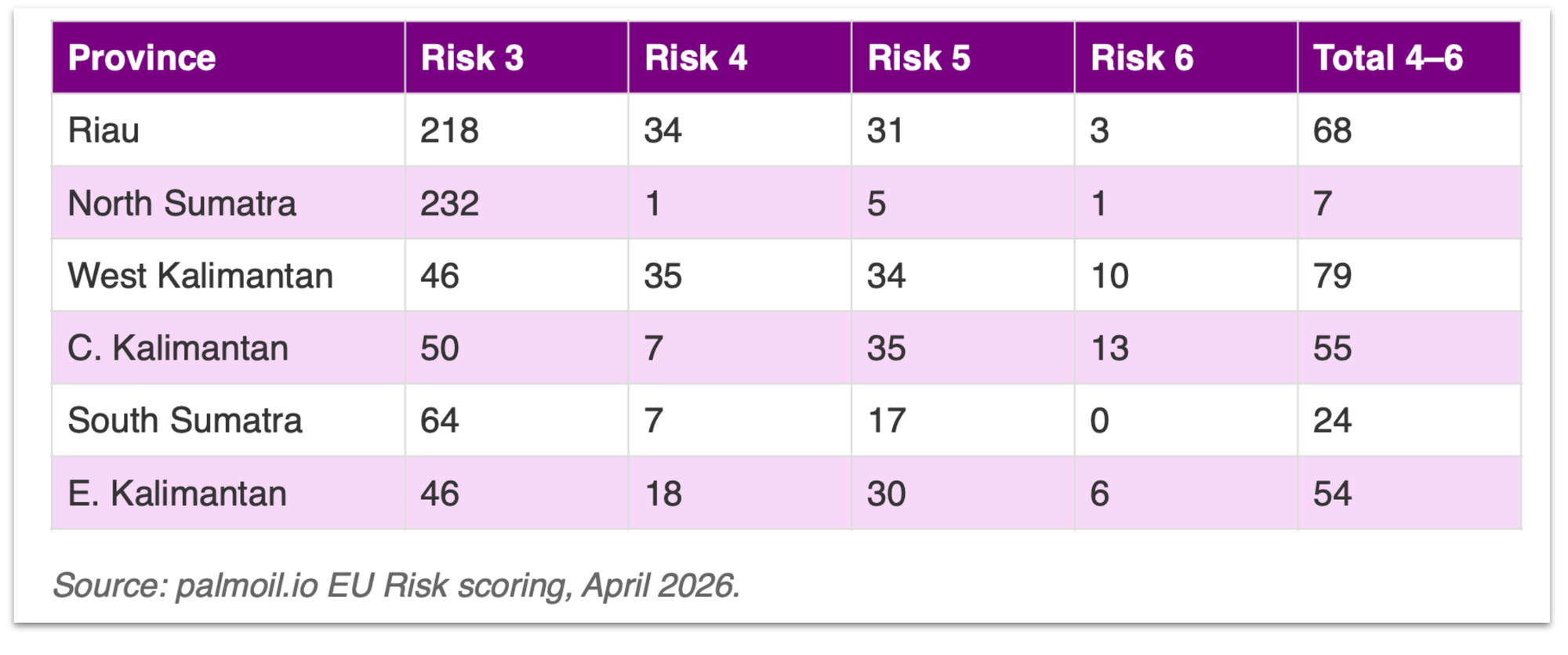
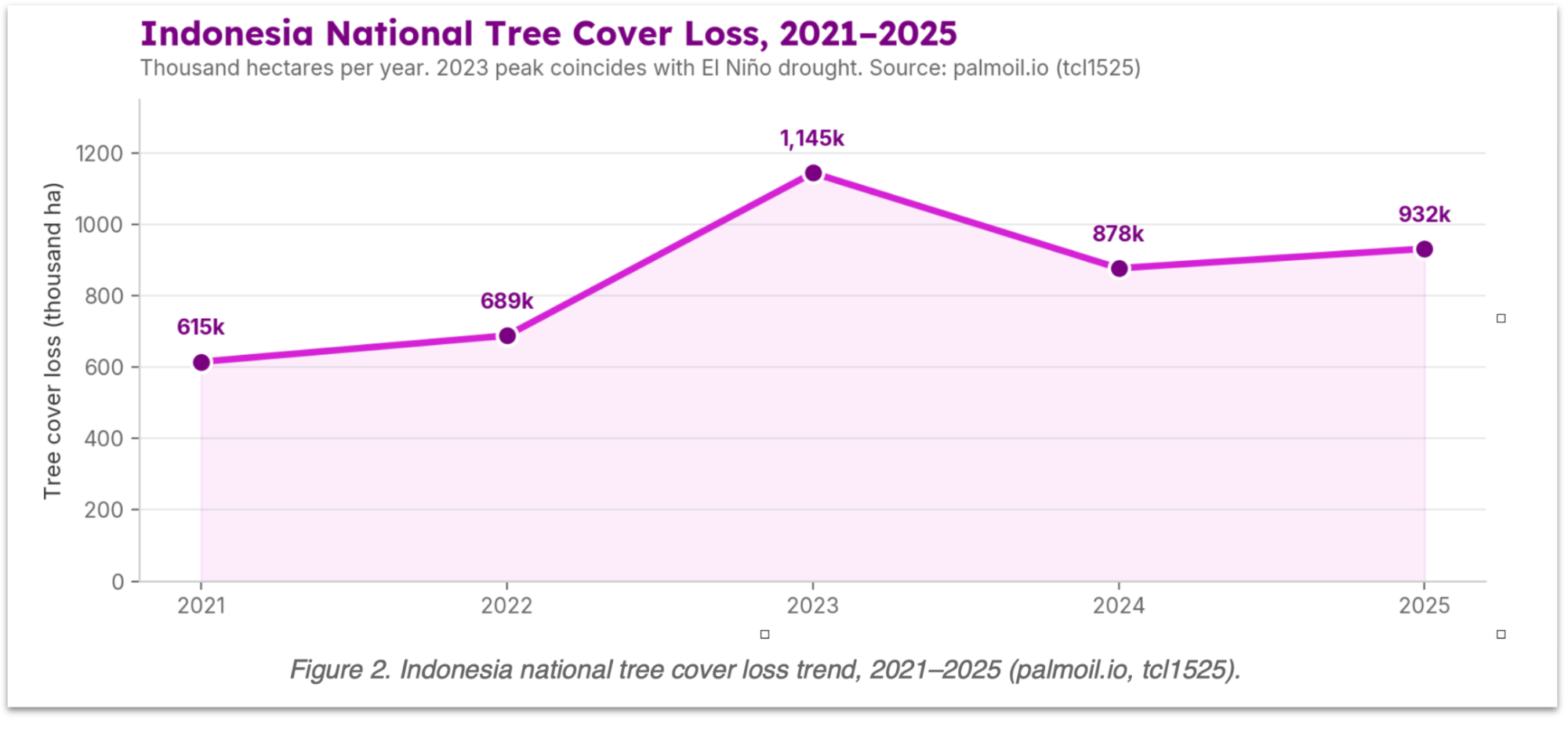
For example, in Indonesia, risk varies significantly between Sumatra and Kalimantan. Some provinces have high mill counts and large production volumes, creating volume risk. Others show higher concentrations of recent deforestation, lower certification coverage, or more active grievances. Frontier expansion areas may carry higher future conversion risk even where current sourcing volumes are smaller.
These distinctions matter for procurement. A supplier in a lower-risk region should not be treated the same way as a supplier operating near recent post-2020 deforestation, unresolved land conflict, or repeated grievance allegations. Regional analysis helps companies focus resources where risk is highest.
Where Palmoil.io adds unique value
The core value of these assessments is the combination of credible public data with Palmoil.io platform intelligence.
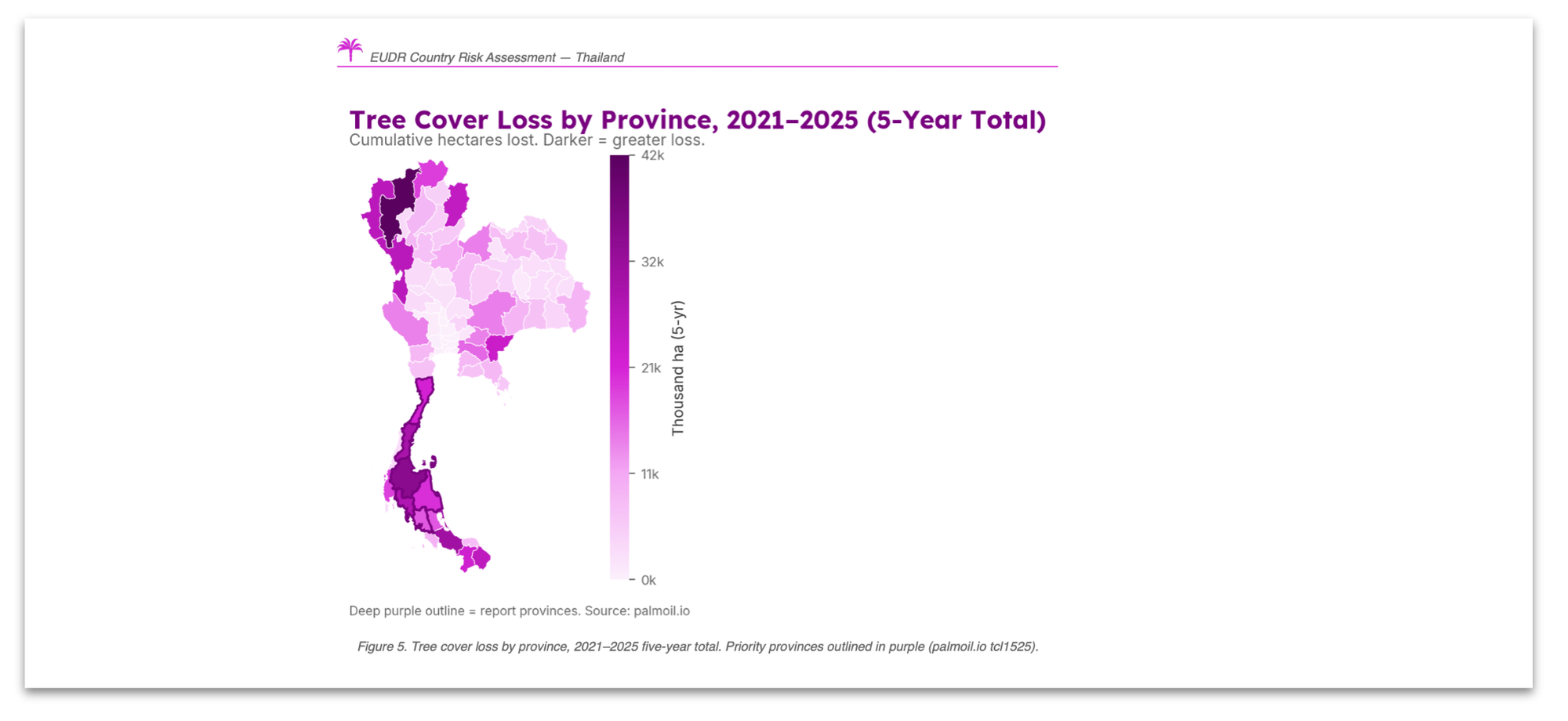
Public sources include EU regulations and guidance, national government datasets, forest monitoring systems, academic research, international organizations, certification bodies, and established NGOs. This gives the reports a transparent and reputable evidence base.
Palmoil.io then adds palm-specific intelligence: supply chain traceability, plot monitoring, EU Risk ratings, satellite-based deforestation analytics, JRC 2020 forest baseline data, tree cover loss trends, RSPO status, analyst-reviewed deforestation reports, and a grievance database covering thousands of cases.
This turns a country report from a generic background document into a practical compliance tool.
By identifying high-volume regions, high-risk mills, active grievances, post-cutoff deforestation signals, and certification gaps, Palmoil.io Country Risk Assessments help companies prioritize supplier engagement, plot-level checks, mitigation measures, and audit-ready documentation.
For EUDR compliance, the goal is not just to know whether a country is risky but where the risk is, why it matters, what evidence supports the conclusion, and what action is required before products enter the EU market. The assessments provide both insight and foresight into not only managing existing risks but preparing for future challenges.
Your first country assessment report is free!
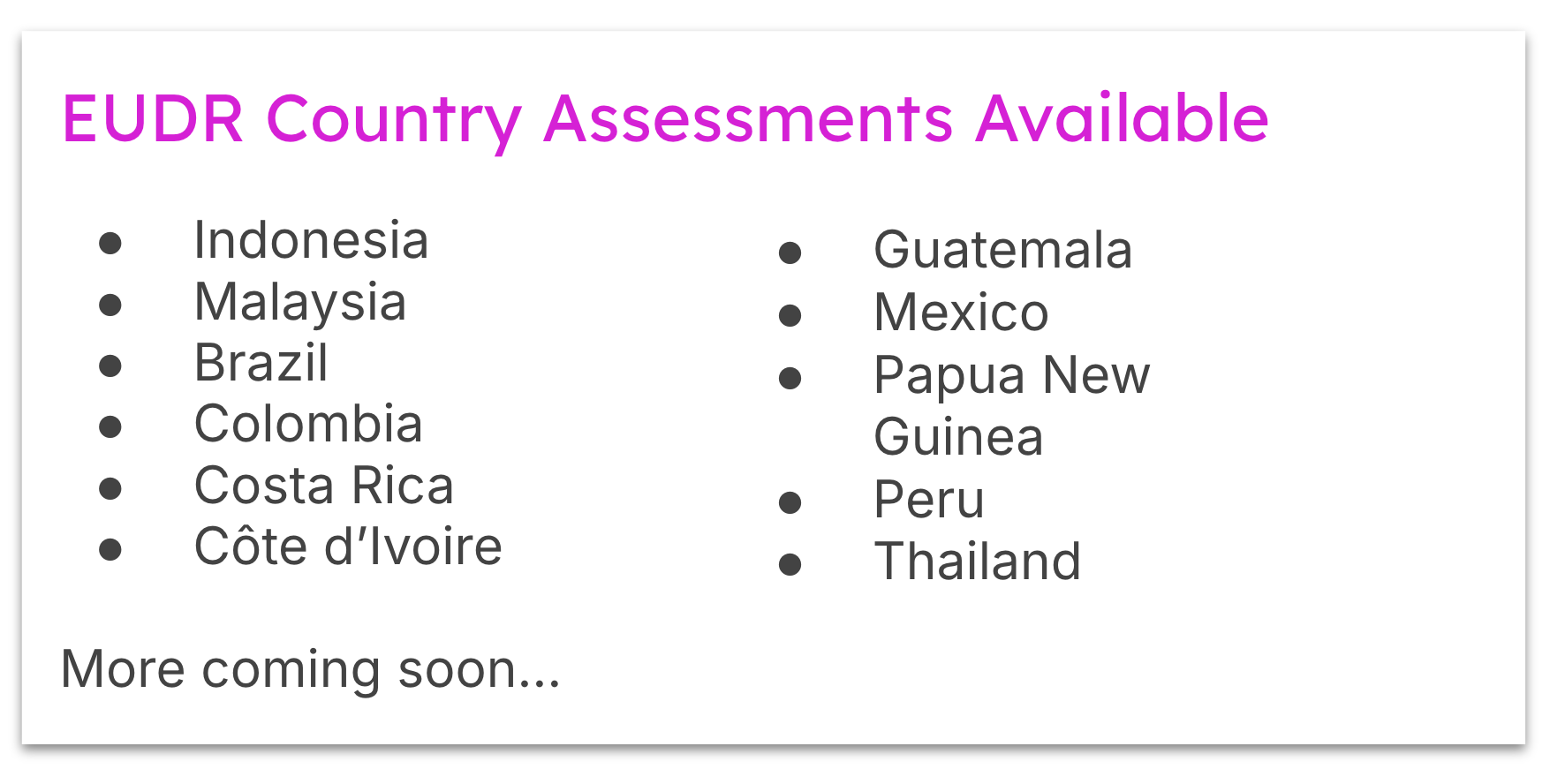
If you subscribe for a free Palmoil.io subscription, we will give you a free country risk assessment of your choice. For further information, please write to info@maphubs.