
Introducing the first performance-based rating for palm oil supply chains
Palmoil.io Ratings launches in November: monthly deforestation and social risk scores for palm oil producers, processors and buyers, ranked against their peers, with no questionnaire. If you publish a mill list, you are probably already rated.

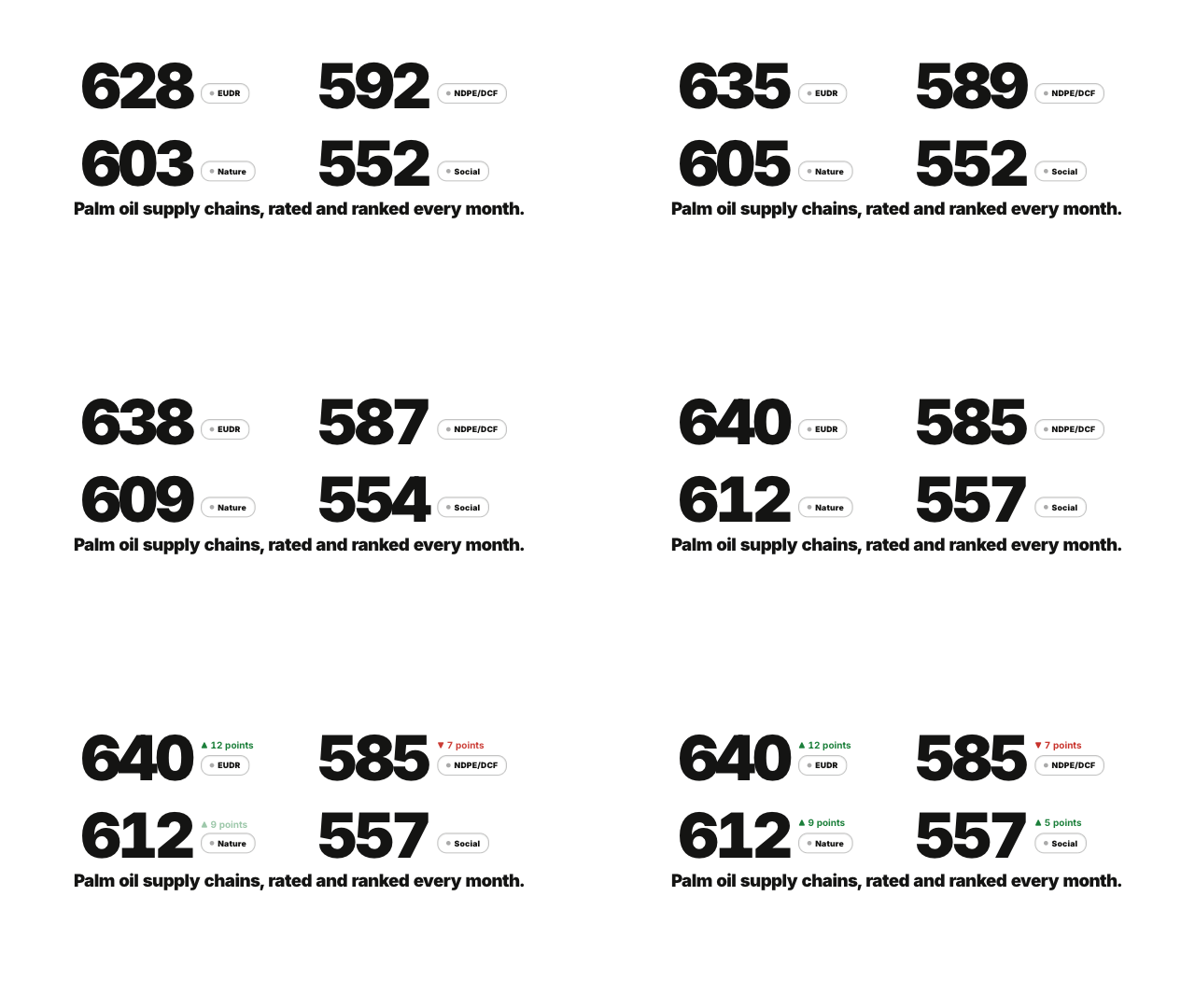
In November 2026, we are launching Palmoil.io Ratings. Ratings is the first platform to rate palm oil producers, processors and buyers on deforestation and social risk every month, using evidence rather than questionnaires. Palmoil.io will rate all known mills, hundreds of refineries and supplier groups, and the ingredient, oleochemical and consumer goods manufacturers that buy from them. If you publish a palm mill list, you are likely already rated.
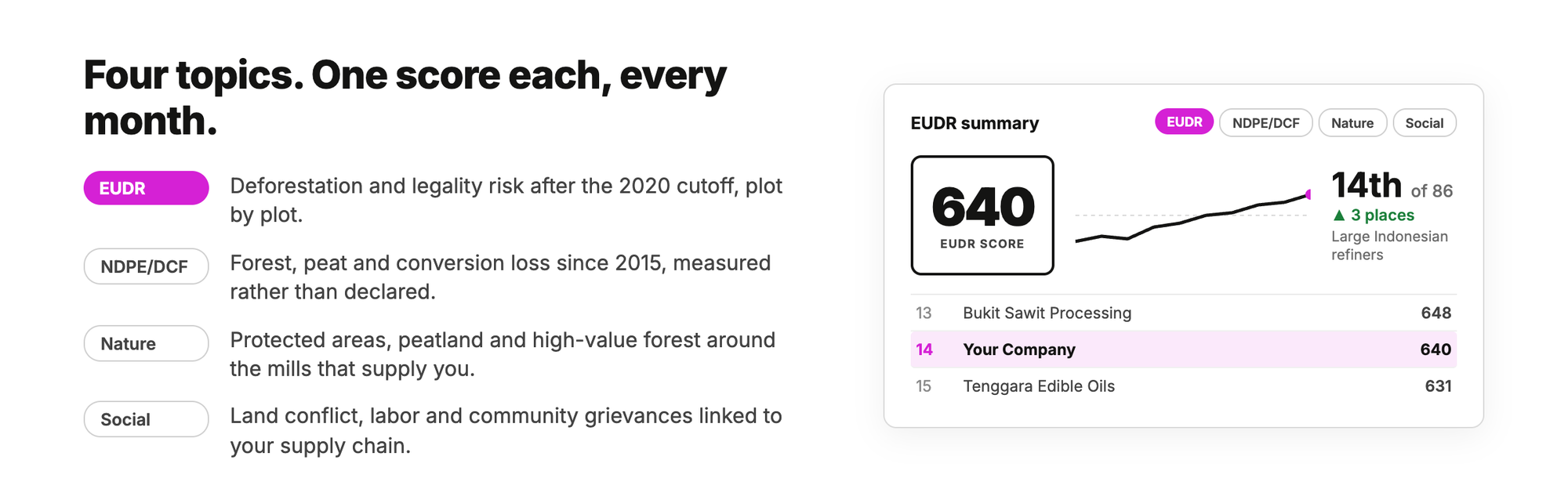
Four topics are rated: EUDR, NDPE/DCF, Nature and Social risk. Scores start with the plots that likely supply each mill, roll up to refineries and supplier groups, and reach downstream companies through their published mill lists. Early access is free for rated companies. Please sign up at palmoil.io/early-access to see your rating before the public launch.
If you are attending RT2026 in Jakarta on November 3–4, book a demo at our booth here. The rest of this post explains how Ratings works.
The problem: companies do not know where they stand
Ratings addresses two problems: comparing risk performance between companies and deciding which risks to act on first.
No standard way to compare supply chains
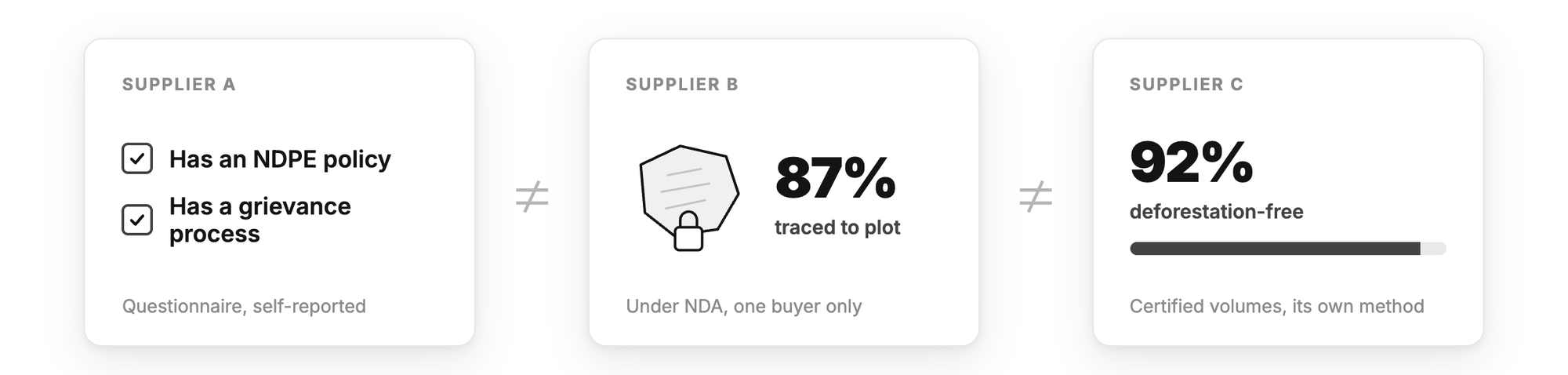
Companies buying and selling palm products cannot measure their risk or compare it with their peers. First, existing rating systems are based on questionnaires that measure policy, not performance. A questionnaire can tell you whether a supplier has an NDPE policy, not whether the supplier is implementing it.
Traceability data is private
Second, traceability to plot (TTP) data is usually proprietary and shared with downstream companies only under non-disclosure agreements. Deforestation-free claims based on private TTP data cannot be independently assessed or compared between companies.
Different DCF methods, different results
Third, there is no standard Deforestation and Conversion Free (DCF) methodology. Some companies use TTP data, others certified volumes, others both. Two companies cannot compare DCF performance unless they use the same method and see each other’s data.
Too many risk signals, no way to rank them
Most companies have no risk monitoring system. Those that do receive hundreds of risk signals a month and have no way to rank them, so serious cases go unseen or unanswered. Most companies act only on grievances filed by watchdogs and customers.
The solution
Palmoil.io Ratings answers these problems.
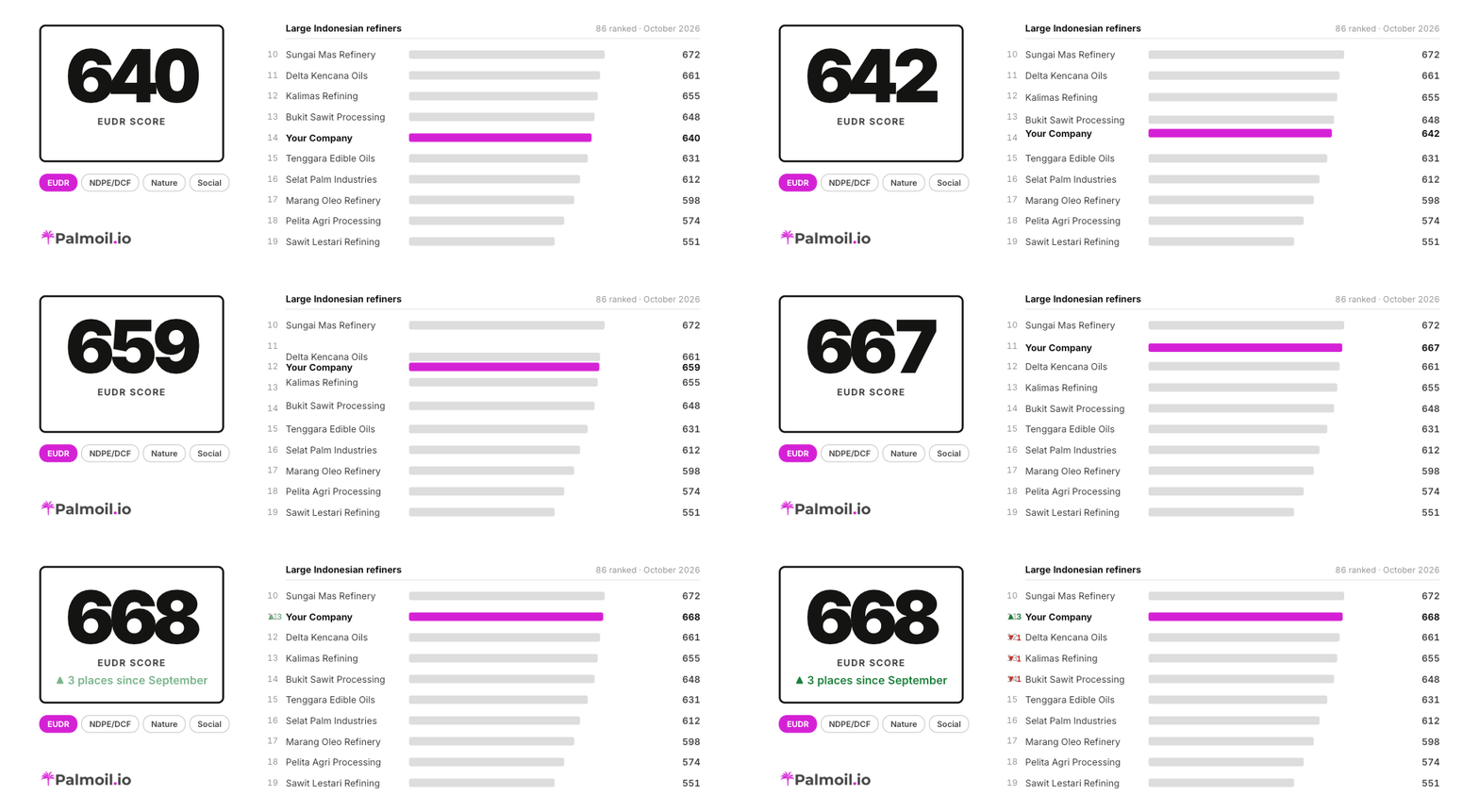
Every month, your deforestation and social risk is rated and ranked. You see how you compare with your peers, which suppliers carry the most risk, and which cases need your attention now.
What a rating tells you
Every company and facility is scored each month on EUDR, NDPE/DCF, Nature and Social risk and ranked against comparable peers. Scores come from analyzing Palmoil.io’s global plot and smallholder area database for deforestation, peat loss and grievances relevant to each topic, and connecting them to the mills they likely supply.
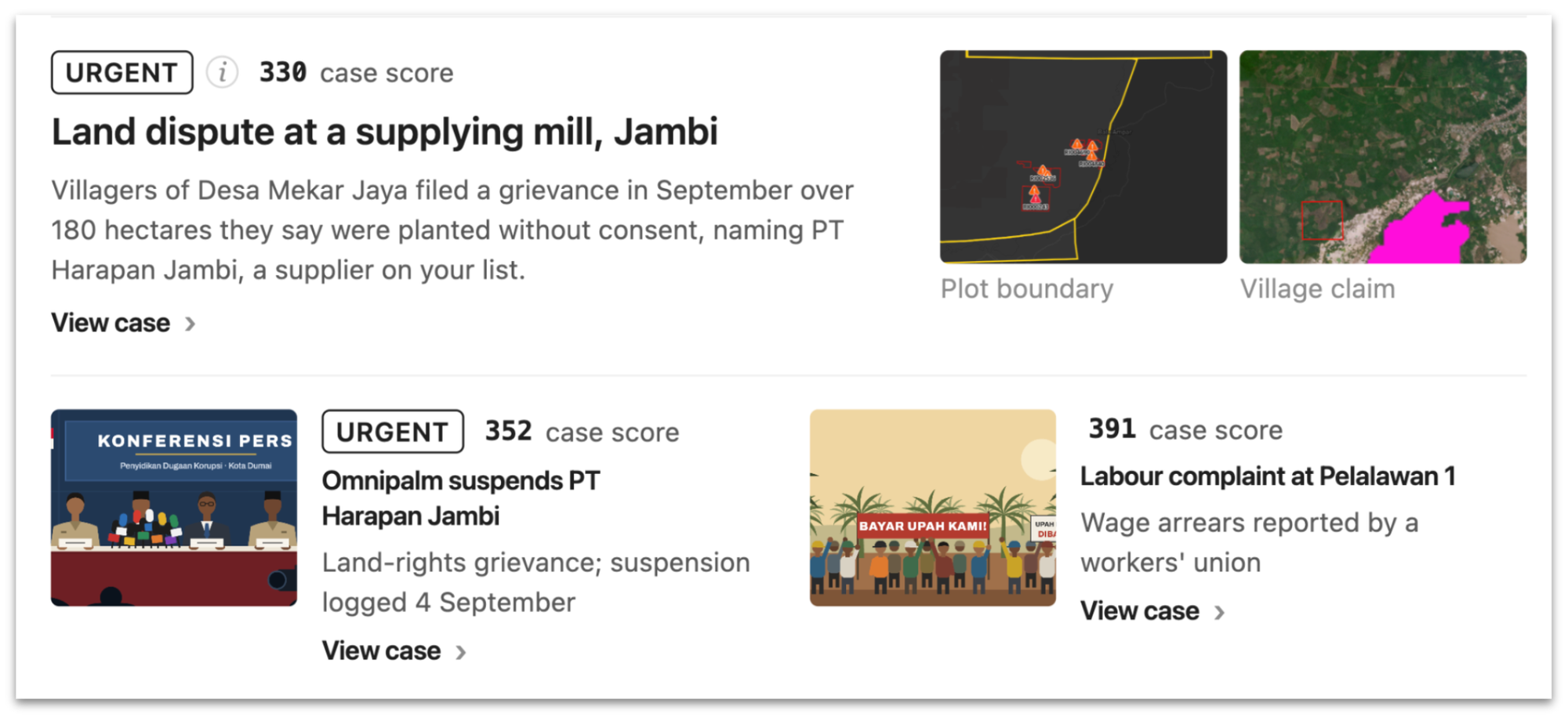
Mill scores roll up to facilities and companies through published mill lists. Companies are scored for each topic and ranked inside a peer group of comparable size and focus (for example, large Indonesian refiners). Each month, the latest results appear on your dashboard and an email summarizing your score and flagging urgent cases arrives in your inbox. There is no questionnaire, and we never ask for your supplier plot data.
For existing subscribers, nothing is taken away. You keep the same data, tools and analytics, with ratings added.
Who is rated?
If you publish a palm mill list, you are likely rated. We have rated the lists of hundreds of refineries and crushers, major growers and traders, ingredient and oleochemical manufacturers, and consumer goods companies.
Every rated company has a primary peer group of direct competitors. Secondary and tertiary peer groups depend on your sector and may include national competitors and related market segments. Your scores and ranks visible to you and to Palmoil.io subscribers, not to the public.
What if I don’t publish a mill list?
If you do not publish a mill list, you can still be rated. Upload your mill list to our Portfolio tool, select a peer group, and Portfolio rates your list against those peers for the topic you select, such as EUDR. You see where you would rank if you published a list. Your result is visible only to you.
What if I have plots?
If you have plot boundaries, you can analyze them for EUDR and NDPE/DCF risk with Plot Check. Uploaded plots are visible only to you and do not affect ratings.
Who are ratings for?
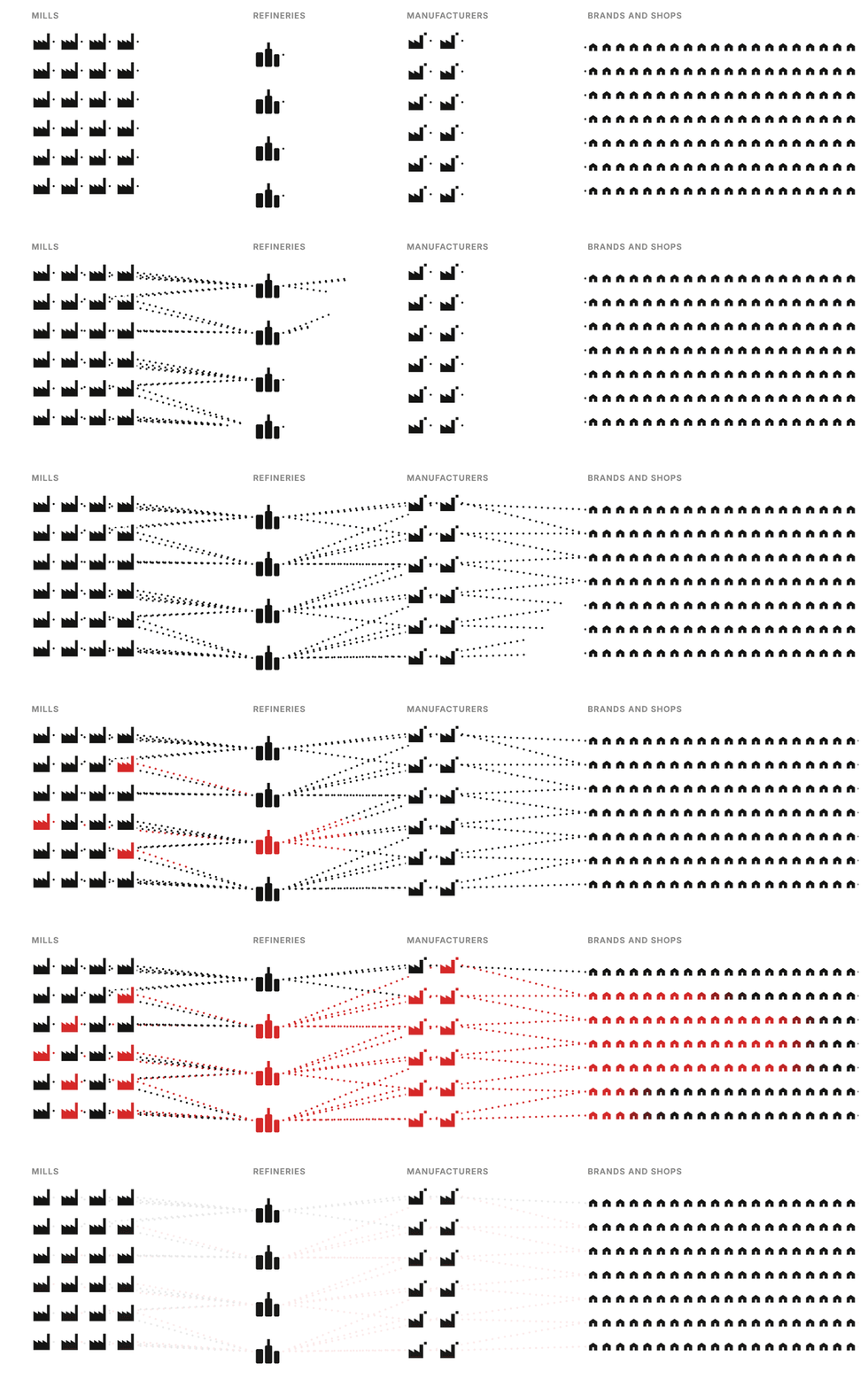
Ratings are for sustainability and procurement teams assessing hundreds of suppliers with limited time. Refiners and producers can compare their refineries’ risk performance with their peers for the first time. Traders and processors can align trading and sustainability teams around supplier ratings backed by evidence.
Oleochemical and ingredient manufacturers with complex palm kernel supply chains can put their buying leverage on the high-risk suppliers and cases flagged at the supplier’s facilities. Consumer goods companies can spend their limited time on the suppliers most likely to harm their reputation, for social harm and conflict as well as deforestation.
Our principles
Palmoil.io Ratings are our independent assessment of deforestation and social risk, built from evidence rather than from what a company tells us. Ratings come from public mill lists and our own monitoring. There is no questionnaire, corrections are free to anyone, and nothing a company buys from us, or declines to buy, changes its rating. Private data uploaded to Plot Check or Portfolio stays private and moves no score, including your own. Full principles here.
What to expect
Palmoil.io Ratings will launch this November. Early access is available to rated companies at https://www.palmoil.io/early-access. Sign up and you will receive a login invitation before ratings go live.
This is an exciting new chapter in Palmoil.io, and we are looking forward to your feedback on ratings, particularly suggestions on how they can improved. We will be holding webinars and other events to explain how ratings work, the data and methods we use, and their purpose. We hope you will join us!